How to Remove Mice From Glue Trap
Glue traps remain a popular choice for homeowners dealing with mice, despite their reputation for being an inhumane method of rodent control. They’re inexpensive (about a dollar per unit) and easy to set up, requiring nothing more than peeling off a protective sheet and placing the board where mice are active.
In fact, a published study found that among surveyed residents who used DIY mouse control products, glue boards were the most commonly reported method (45%), followed by rodenticides (21%) and snap traps (17%).
Despite their popularity, glue boards pose a particular challenge: they don’t always kill mice outright.
You may find yourself staring eye to eye with a live mouse struggling to free itself from the adhesive. What do you do then? Trying to pull it off can seriously injure the animal, while handling a frightened mouse also puts you at risk of getting bitten.
This guide explains how to handle the tricky task of removing mice from glue traps while minimizing the risk of injury to yourself and the animal.
Steps to Remove Mice From Glue Traps Safely
The following steps can help you release the mouse from the adhesive as carefully as possible without causing further harm.
Step 1: Put on Gloves and Secure the Trap
Wear thick, bite-resistant gloves before handling the trap. Rubber gloves can help reduce contact with contamination, but ordinary thin rubber gloves won’t reliably protect against bites.
Move the trap to a quiet, enclosed area away from children and pets. Handle the board by its edges and avoid touching the mouse directly.
If the mouse is struggling, gently steady it with a small towel without squeezing its body or obstructing its breathing. You can also cover exposed adhesive with paper towels to prevent it from becoming stuck again.
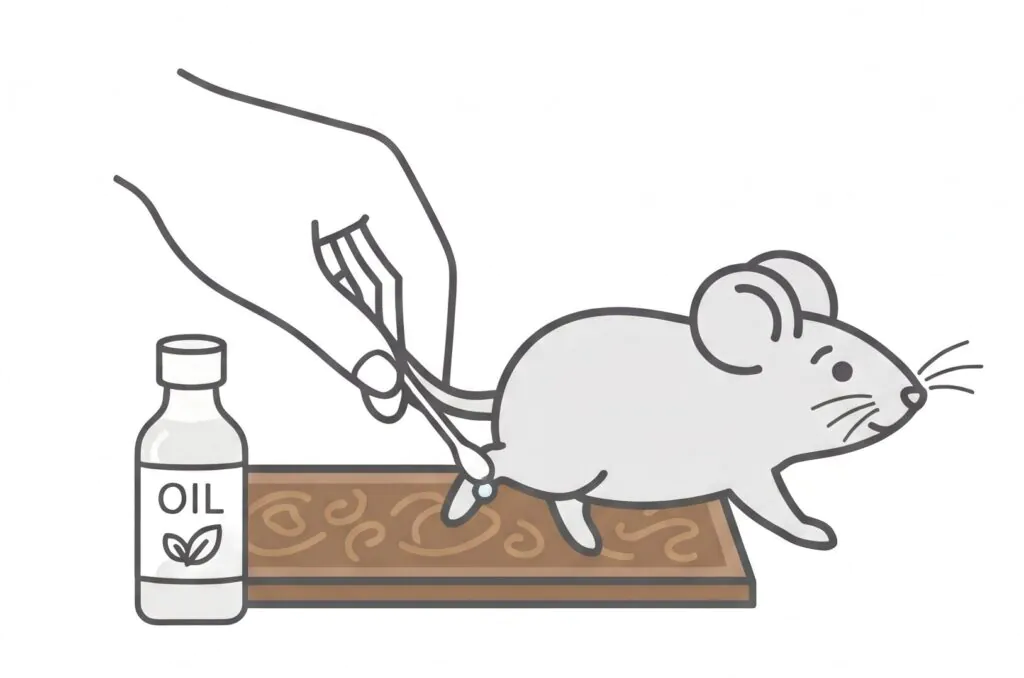
Step 2: Apply Cooking Oil to Loosen the Adhesive
Warm a small amount of vegetable or canola oil until it’s lukewarm (too hot will scald the mouse).
Using a cotton swab, gently work the oil toward the base of the fur or the areas of skin where it meets the adhesive, giving it time to loosen the glue’s grip. Patience is key here, as you may need multiple tries before the mouse comes free. Never pull or pry the mouse away from the trap, as doing so could further injure it.
Step 3: Transfer the Mouse Into a Container
After freeing the mouse, gently blot away excess oil with a soft cloth or paper towel if you can do so safely.
Place the mouse inside a secure container. A tall, smooth-sided container may be enough to prevent it from escaping, but one with a secure lid and ventilation holes is preferable in case the mouse knocks it over.
Step 4: Release the Mouse
Choose a location away from your home so it doesn’t find its way back inside and put you through the same ordeal again. Place the container on the ground, open it, and allow the mouse to leave on its own. Don’t shake the container or attempt to grab the mouse to force it out.
Step 5: Dispose of the Glue Trap and Clean Up
Cover the exposed adhesive with paper towels and place the used glue board inside a plastic bag. Seal the bag tightly, or double-bag it if the first bag is at risk of tearing or leaking. Then, dispose of it in a lidded outdoor garbage can.
Next, clean any surfaces contaminated with mouse urine or droppings. Spray the affected areas with a household disinfectant, allow it to sit for the contact time specified on the product label, and wipe everything up with paper towels. Dispose of the used towels in a sealed plastic bag.
Do not sweep or vacuum dry rodent waste. Doing so can stir up dust containing potentially infectious particles that you could inhale.
If there’s nearby clutter, such as cardboard boxes or old newspapers, check for signs of contamination and discard any heavily soiled materials that can’t be properly disinfected.
Finally, remove your gloves and wash your hands thoroughly with soap and water.
What If the Mouse Is Already Dead on the Glue Trap?
Unfortunately, death is a common outcome for mice caught in glue traps. Even if you find the mouse alive, following the steps above doesn’t guarantee its survival. It may have already spent hours struggling to free itself before you found it, or the stress of being removed from the adhesive may prove too much for it.
This is one of the limitations of glue traps. They’re effective at catching mice, but if you’re looking for a more humane way to deal with rodents, you may want to consider other methods.
If the mouse has already died, dispose of the entire glue trap. Don’t attempt to peel the dead mouse off the board, as this creates unnecessary contact with the animal and the contaminated adhesive.
While wearing gloves, spray the dead mouse and glue board with a household disinfectant. Then place the entire trap in a plastic bag, seal it, and double-bag the waste before disposing of it in a secure outdoor trash bin. Make sure to disinfect the surrounding area and remove mouse droppings and urine.
How to Get Mouse Trap Glue Off
As you handle a glue trap, there’s always a chance that some of the sticky adhesive will end up on your hands or clothes. And if you’ve ever accidentally touched one of these traps, you know just how stubborn that glue can be. Below are some ways to remove mouse trap glue without damaging your clothes or irritating your skin.
Removing Glue From Skin
If mouse trap glue gets on your hands or skin, use vegetable oil, baby oil, or mineral oil to help loosen the adhesive. Apply a small amount of oil to the affected area and gently rub it into the adhesive to help break down its grip on your skin.
Once softened, you should be able to easily wipe away the residue with a soft, dry cloth or paper towel. Repeat the process if any adhesive remains
Wash the affected area thoroughly with soap and water to remove any remaining oil and adhesive.
Removing Glue From Clothes
The easiest way to remove mouse trap glue from clothing is to freeze the affected garment until the adhesive hardens. If that’s not feasible, you can instead hold an ice pack against the adhesive to help it solidify.
Afterward, peel away the adhesive, starting at the edges and working inward. Avoid pulling too hard, especially on delicate fabrics. Once you’ve removed as much of the glue as possible, you can then wash the garment as usual.
Why You Should Think Twice Before Using Glue Traps
As you can tell from the steps above, freeing a mouse from a glue trap can be quite a hassle. And even if you manage to get it off the adhesive, there’s still a chance it won’t survive after spending hours desperately trying to break free.
That brings us to perhaps the biggest issue with glue traps: animal welfare. In fact, concerns over their cruelty have led places like England, New Zealand, and Ireland to ban or restrict their use. Even major retailers, including Target, Walgreens, and Dollar Tree, have stopped selling them.
Beyond these concerns, below are several other reasons you might want to reconsider using glue traps for mice.
Pets and Other Animals Can Get Stuck
Glue traps don’t discriminate between mice and other animals. Curious cats and dogs can accidentally step on the adhesive, leaving their paws or fur stuck to the board. While the adhesive itself isn’t poisonous, removing it can be painful and stressful.
Smaller animals, such as birds, lizards, and other small mammals, are at even greater risk of getting stuck. They can become completely immobilized, and their futile attempts to escape often result in injuries or exhaustion that can ultimately lead to their demise.
Mice Can Learn to Avoid Glue Traps
Mice are incredibly smart creatures. They’re especially adept at recognizing danger in their surroundings, thanks to their strong sense of smell, good spatial memory, and ability to learn from previous encounters.
These traits make them deft navigators. A mouse that encounters a glue trap and manages to escape may learn to avoid it the next time.
That’s why exclusion methods, such as sealing gaps around pipes, doors, and foundations, are an essential part of professional rodent control. They physically prevent mice from entering your home in the first place, regardless of how intelligent or resourceful they are.
Glue Traps Can Increase Your Exposure to Pathogens
Glue traps can give you a false sense of security. You might start believing that a constant stream of trapped mice means their population is getting smaller and smaller, when the opposite could very well be happening.
There’s also the risk of getting bitten, as a frightened mouse may instinctively lash out in self-defense.
Beyond bites and direct contact with contaminated surfaces, you should also be mindful of hantavirus, which can spread when infected rodent urine, droppings, or nesting materials are disturbed and contaminated particles become airborne.
Glue Traps Don’t Solve the Underlying Mouse Infestation
Glue traps can give you a false sense of security. You might start believing that a constant stream of trapped mice means their population is getting smaller and smaller, when the opposite could very well be happening.
Mice reproduce at an alarming rate, with female house mice capable of producing 5–10 litters per year, each containing five or six pups. Those offspring can begin reproducing at just six weeks of age. So, while you’re catching a few mice here and there, there may be reinforcements arriving in your attic, garage, or basement.
Come to think of it, it’s almost as if the mice themselves have turned the tables and trapped you in an endless battle!
Protect Your Home From Mice With Modern Pest
Trapping, generally classified as a mechanical control method, is just one of the many components of Integrated Pest Management (IPM), an approach recommended by the Environmental Protection Agency (EPA) that we at Modern Pest also follow.
Beyond catching individual mice, we also use inspections, exclusion methods, sanitation, and targeted treatments to address existing mouse activity and the conditions that allow infestations to persist.
This comprehensive approach helps us address the infestation at its source rather than simply dealing with rodents as they appear.
We also offer the Anticimex SMART Rodent Control System, which uses connected electronic traps to monitor rodent activity around the clock. When a trap is triggered, the system sends an alert to our technicians, allowing us to track activity and respond promptly, so you won’t have to wait until the next scheduled inspection.
Take the first step toward a mouse-free home! Call Modern Pest today at (800) 323-7378 or contact us to schedule a rodent inspection.