3 Key Differences between Winged Termites and Flying Ants

Updated October 2017.
After a long, cold winter, especially the one we just had in New England, spring is a welcome guest. The bugs that come with it are not.
Two, in particular, are waking up right now. They’re small, they live in large colonies, and their presence is disturbing to homeowners. These are termites and carpenter ants, and they’re about to swarm.
Got Swarmers? Call a knowledgeable licensed professional at (800) 323-7378 or contact us to request a FREE Quote, ask us a question or Schedule a Service!
Swarmers are what the professionals call “the winged” termites and carpenter ants. They’re mostly females, and their sole purpose is to reproduce with males and establish new colonies.
To you, carpenter ants and termites swarmers may look the same – they’re black with wings. Because of these similarities, many people can’t tell them apart. A carpenter ant treatment is very different from a termite treatment, so it’s important to know which one is nesting in or around your home. The good news is that you don’t have to be an expert to tell termites from carpenter ants.

3 Things to Look For:
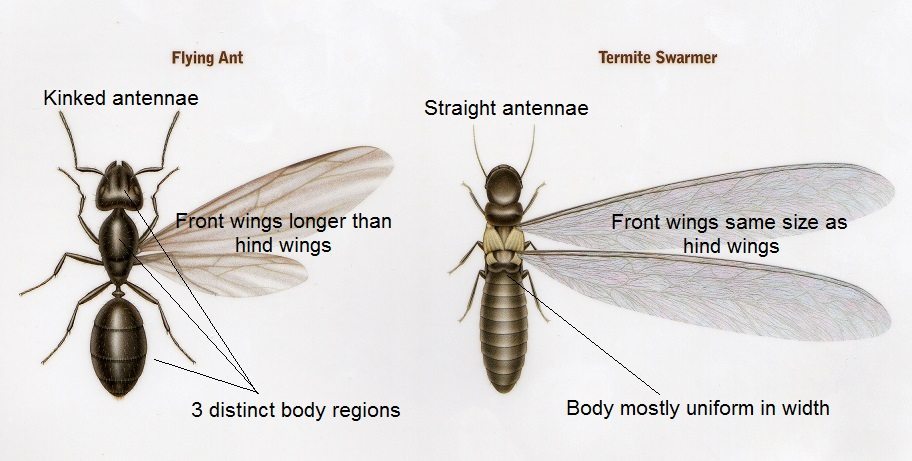
Bent or Straight Antennae?
- If you take a close look at the antennae of a carpenter ant, you will see that they are bent.
- Termite antennae are straight. They are also shorter than carpenter ant antennae.
Distinct Body Regions or Uniform Width?
- All insects have three body regions – the head, the thorax, and the abdomen. These regions are not always apparent in all insects, though.
- Termites’ bodies look somewhat uniform in width (the 3 regions are not apparent). Carpenter ants’ bodies do have 3 distinct regions that you will be able to see.
Wings: Same or Different Length?
- Both carpenter ants and termites have two pairs of wings, meaning they have four all together. There is a front pair and a back pair. On termites, both the front and back pair of wings are the same length. On carpenter ants, the back wings are significantly shorter than the front wings.
- The wings for termites and carpenter ants tend to go straight back and can be difficult to see whether or not they’re the same length. What you will be able to see are the colors of the wings. Carpenter ant wings have a brown tint to them. Termite wings are white and translucent.
If you see swarmers of either type in your home, then you should be concerned. This is a sure sign that a nest is very close by. If you see swarmers, call a professional immediately, and do not attempt to treat on your own. Home solutions seldom work on carpenter ants, and never for termites.
Learn more about: Carpenter Ant Damage and Termite Season
The Modern Difference
If you’re still unsure whether the swarmers you see are carpenter ants or termites, email a picture to info@modernpest.com. As long as the picture is clear and detailed, we will be able to identify the pest and determine the best route of action.
Every season brings a new threat from pests. Be prepared. Modern Pest Services offers a HomeCare Green Program for year-round pest protection, as well as Wildlife, Termite, Mosquito, Tick, and Bed Bug Control Services. With seasonal treatments designed to target New England’s unique pest concerns, our highly trained team of professionals have the skills, equipment, and knowledge it takes to tackle any pest issue – guaranteed!
Contact the trusted pros at Modern Pest for a Free Quote today! or Call (800) 323-7378.
Why Accurate Swarmer Identification Matters for Your Home
Both eastern subterranean termites and carpenter ants produce winged reproductive swarmers in New England, particularly during warm spring days—or earlier indoors near heated foundation walls. Because subterranean termites feed on cellulose in wood and require specialized termite baiting or liquid treatments, whereas carpenter ants excavate galleries in damp wood without eating it, identifying discarded wings and body shape early ensures the right treatment approach. For more on carpenter ant signs, read how to get rid of carpenter ants in your home.
Schedule a Professional Wood-Destroying Insect Inspection
If you find discarded wings along windowsills, mud tubes on foundation walls, or piles of coarse wood shavings, a licensed technician can confirm which insect is active. Review our wood-destroying pest identification guide and explore our termite treatment and monitoring options.
Related Articles
Termite Activity Doesn’t Fully Stop in Winter
Eastern subterranean termites live in the soil and can stay active below the frost line, especially near heated basements and foundations. Mud tubes on foundation walls and swarmers with four equal-length wings are key signs that set them apart from carpenter ants. For more, see our carpenter ant identification and removal guide.
Professional Termite Protection
Protecting your home means treating the colony, not just the termites you can see. Learn about our termite treatment options and use our wood-destroying pest guide to recognize the warning signs.