
Cluster Flies vs Flesh Flies: Differences, Risks, and Prevention
For many homeowners in New England, the arrival of fall also marks the return of an unwelcome seasonal visitor: flies.
Most are cluster flies, gathering around windows and making their way into attics and wall voids in search of a place to overwinter. Every so often, however, the culprit is a flesh fly drawn by something far less welcome, such as a dead rodent hidden somewhere in or around the home.
Knowing which fly you’re dealing with goes well beyond putting a name to it. It explains why they’ve shown up, whether they’re a cause for concern, and how best to get rid of them.
Cluster Flies vs Flesh Flies at a Glance
| Feature | Cluster Flies | Flesh Flies |
| Size | 1/4 to 3/8 inches long | 3/8 to 1/2 inches long |
| Appearance | Dull gray with golden-yellow hairs on the thorax | Gray to black with red eyes and a stout, bristly body |
| Distinctive markings | Slightly fuzzy, mottled appearance | Three dark stripes on the thorax and a checkerboard-patterned abdomen |
| Movement | Slow, sluggish fliers that often gather in groups | Faster, more agile fliers |
| Typical habitat | Outdoors in soil during warmer months; attics and wall voids when overwintering | Usually outdoors around carcasses, animal waste, garbage, and decaying organic matter |
| Why they enter homes | Seek warmth and shelter as temperatures fall | Usually enter or emerge indoors when a dead animal or other breeding source is nearby |
| Breeding habits | Larvae parasitize earthworms in the soil | Females deposit live larvae on carrion and other decaying organic matter |
| Health risk | Primarily a nuisance; don’t bite or transmit known diseases | Can carry bacteria associated with foodborne and gastrointestinal illness |
| Main control method | Seal exterior gaps before their autumn migration indoors | Find and remove the carcass or other breeding source |
Check out our Pest Library: Flies to learn more about other fly species that may be infesting your home.
Physical Appearance and Identification
Identifying cluster flies
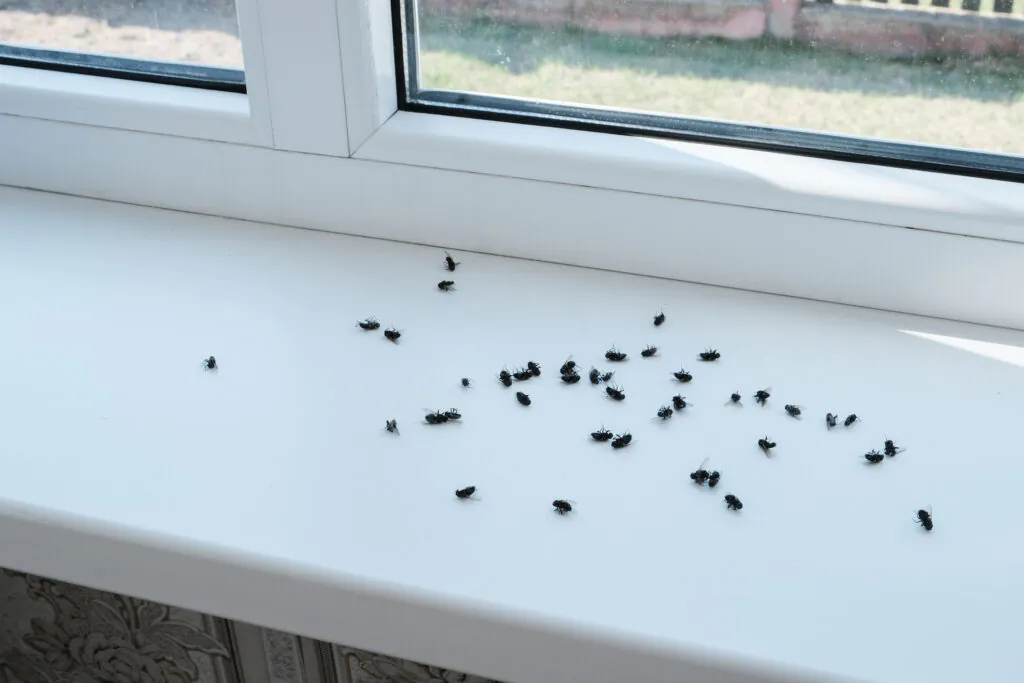
Cluster flies are easy to spot since, as the name suggests, they gather in clusters. You’ll find groups of these less-than-half-inch flies around wall voids, attics, and windows, especially as they overwinter indoors.
Adult cluster flies are dull gray with golden-yellow hairs covering the thorax, giving them a slightly fuzzy, mottled appearance.
They closely resemble house flies, with the most distinguishing feature being how they hold their wings at rest. Cluster flies keep their wings overlapping across their back, while house flies typically hold theirs in a triangular position.
Identifying flesh flies
Flesh flies are much larger than cluster flies, with adults reaching up to 3/4 inch in length. They’re also quicker and more agile compared to the sluggish, lazy-buzzing cluster flies.
Their bodies are more robust and bristly, with a stout build and conspicuous red eyes that stand out against their darker body.
Similar to house flies, adult flesh flies are gray to black. Most common species have three dark longitudinal stripes running down the thorax and a distinctive checkerboard pattern across the abdomen.
Habitat
Cluster fly habitat
Cluster flies are outdoor pests by nature. They lay their eggs in moist, fertile soil, often near earthworm burrows, exploiting the earthworms’ toil by positioning their larvae within easy reach of a host.
That said, farms, pastures, gardens, lawns, and other areas with fertile, well-drained soil are more susceptible to cluster fly infestations, as these environments are also conducive to healthy earthworm populations.
After spending several weeks parasitizing a living earthworm, the larva pupates in the soil before emerging as an adult cluster fly.
It then seeks sheltered places during the winter, most commonly secluded areas of the home such as wall voids and attics. That’s why they’re sometimes referred to as “attic flies.”
Flesh fly habitat
Flesh flies thrive outdoors, feeding on and depositing their live larvae directly onto the carcasses of squirrels, rabbits, birds, rodents, and other wildlife. They also breed in animal dung, decaying organic matter, and meat scraps found in rubbish bins.
In theory, you’re unlikely to find these erratic flies indoors. If you do, particularly if they’re repeatedly appearing in the same room, it’s reasonable to suspect a dead animal behind a wall or ceiling void.
Sometimes, though, the source can be just outside the home, such as a dead animal trapped beneath solar panels or under a deck.
What Attracts Them
What attracts cluster flies to your house
Cluster flies don’t come indoors looking for food. Instead, they’re drawn by the warmth and shelter a home offers.
As temperatures begin to fall, they gather on the sunniest sides of buildings, most often south- and west-facing walls. The warmth helps them locate small cracks and crevices that lead to sheltered overwintering sites such as attics and wall voids.
What attracts flesh flies to your house
If you’re finding flesh flies indoors, the most likely explanation is that they’ve found a suitable food source or breeding site nearby. Common attractants include:
- Dead birds or rodents hidden behind walls, ceilings, crawl spaces, or attics
- Animal carcasses trapped beneath solar panels, under decks, or inside sheds
- Overflowing rubbish bins containing meat scraps or other decaying organic matter
- Pet waste left to accumulate around the yard
Health Risks
Cluster flies
In New England, cluster flies are one of the signature fall nuisance pests. Thankfully, that’s largely all they are.
They don’t bite people or pets. Nor are they known to transmit diseases, which, in large part, is due to their life cycle revolving around soil and earthworms, and their flower-nectar diet – a “clean” environment far less associated with disease-causing pathogens.
Flesh flies
Flesh flies are a stark contrast in this regard. They routinely land and feed on rotting meat, animal carcasses, feces, garbage, and other decaying organic matter before flying elsewhere.
Along the way, they can pick up bacteria and other pathogens on their bodies and mouthparts, contaminating food preparation surfaces and exposed food if they make their way indoors.
Some of the bacteria associated with flesh flies include Salmonella, Escherichia coli (E. coli), and Shigella, all of which are capable of causing food poisoning, diarrhea, and other gastrointestinal illnesses.
Control and Prevention
How to get rid of cluster flies
The best way to get rid of cluster flies is through exclusion, in other words, keeping them from getting inside in the first place. Inspect your home’s exterior and seal any cracks or gaps, paying particular attention to:
- Windows and door frames
- Window screens and weather stripping
- Exterior siding, brickwork, and foundation cracks
- Rooflines, eaves, soffits, and fascia boards
- Attic vents, gable vents, and roof vents
- Openings around plumbing pipes, electrical cables, and HVAC penetrations
Ideally, do this in late summer, ahead of cluster flies’ autumn migration indoors.
You can also complement exclusion with pungent-smelling essential oils such as peppermint, lemongrass, citronella, or citrus oils. These won’t eliminate an infestation on their own, but they may help discourage flies from lingering around treated areas while leaving your home smelling fresh.
If you decide to use an over-the-counter insecticide, treat it as a last resort. Be sure to vacuum and dispose of any dead flies afterward. When otherwise left behind, they can become a food source for carpet beetles and other scavenging pests.
How to get rid of flesh flies
Getting rid of flesh flies is much simpler than dealing with cluster flies, as it comes down to two things: finding and removing the attractant.
Repeated flesh fly sightings in the same area, alongside a rotting odor, can help you narrow down the location of the dead animal. Depending on where the carcass is located, you may need to remove an access panel or open part of the wall or ceiling to get to it.
Once found, dispose of the carcass properly in a sealed rubbish bag or bin. Thoroughly clean and disinfect the surrounding area to remove any remaining organic matter and odors that could continue attracting flies.
Other preventive measures include keeping on top of your pet’s waste, emptying rubbish bins regularly, and promptly disposing of meat scraps or other decaying organic matter around your property.
When to Call Professional Fly Control Services
Most fly problems can be resolved using the preventive measures and treatments covered above. If you’re stuck in a cycle of treating the problem only for the flies to return, it’s time to bring in a professional.
Consider professional cluster fly control if:
- Hundreds of cluster flies continue emerging even after you’ve vacuumed them up and sealed obvious entry points.
- Cluster flies return every autumn, despite repeated exclusion work around the home.
- Flies have established multiple overwintering sites inside your home.
- Your home has multiple rooflines, dormers, soffits, or other hard-to-reach exterior features that make thorough exclusion difficult.
- You still can’t identify how the flies are getting inside after inspecting common entry points.
Consider professional flesh fly control if:
- Locating or removing a dead animal yourself isn’t feasible, either because you’re uncomfortable doing it or physically unable to.
- Reaching the suspected carcass requires invasive work to open walls, ceilings, or other structural elements.
- Flesh flies continue appearing after you’ve removed obvious attractants.
- The infestation returns shortly after the source has supposedly been removed, suggesting another hidden carcass or breeding site.
Protect Your Home From Flies and Other Household Pests
Modern Pest’s HomeCare Green program provides year-round protection against more than 55 common household pests, including cluster flies and flesh flies.
Rather than relying on blanket pesticide applications, our technicians follow the principles of Integrated Pest Management (IPM) to deliver targeted, long-term pest control while minimizing unnecessary pesticide use.
Call Modern Pest today at (800) 323-7378 or contact us online to request your FREE quote.
FAQs
Are flesh flies dangerous?
Flesh flies can pose a health risk because they feed and breed around animal carcasses, feces, garbage, and other decaying organic matter. They can pick up bacteria such as Salmonella, E. coli, and Shigella and transfer them to food or food-contact surfaces.
Are cluster flies hard to get rid of?
Cluster flies can be difficult to get rid of once they’ve settled indoors. Sealing exterior gaps before fall arrives is one of the most effective ways to keep them out.
How long does a cluster fly infestation last?
Cluster flies can remain inside a home throughout the winter. They spend the colder months in a dormant state (called diapause), but may emerge around windows and other sunny areas during warm spells, and even into early spring.
What keeps flesh flies away?
Removing their food and breeding sources is the most effective way to keep flesh flies away. As soon as you discover them, remove animal carcasses, clean up pet waste, keep rubbish bins tightly closed, and regularly dispose of meat scraps.